IoT integration services and edge platforms
We design, build and support software for connected devices, from the code on each edge device to the cloud platform and the apps your operators use.
Trusted by established organisations across Australia
Government, health, energy, education, finance and enterprise.






Software for connected devices in the field
Our IoT integration services connect the edge devices on each site, the cloud platform that collects their data, and the web and mobile apps people use to run the fleet. These three layers often come from different suppliers. Our IoT software development covers all three, and we make them behave as one system.
We work with companies bringing a connected product to market, and with organisations that run equipment across many buildings and sites. In government and enterprise, a fleet like that usually comes with security reviews and uptime targets, and we plan for both from the first design.
Our in-house Australian team has designed, built and supported software since 2008. We build and support edge and IoT platforms running across many sites for several organisations, and can look after a platform from the first prototype device to the day-to-day support of the fleet.
What our IoT integration services cover
A new connected product usually needs every layer below. An existing fleet often needs one or two of them rebuilt, and we can start at any one of them. Some engagements start with IoT consulting, a written review of the devices, network and cloud platform before any code changes.
- Device softwareApplications and services on edge devices, gateways and site controllers, typically running Linux
- Hardware integrationSensors, controllers and third-party equipment, connected over serial, network or vendor interfaces
- Edge-to-cloud dataTelemetry pipelines and two-way sync of settings and device state between site and cloud
- Cloud IoT platformDevice registry, data storage, rules and alerting on Azure, AWS or another cloud
- Operator dashboardsWeb apps that show fleet health, faults and site status on a map
- Field appsMobile apps for technicians who install, test and service devices on site
Industrial IoT and commercial building systems raise the stakes for every layer, because the equipment controls something physical and people on site rely on it through the day. That shapes how we design our IoT services, beginning with the software on each edge device.

Designing software for edge devices
On each site, the edge device is where the fleet meets the equipment. When we design its software, we draw on the cloud providers’ published IoT guidance, such as the AWS Well-Architected IoT Lens and Microsoft’s device configuration best practices for Azure IoT Hub. We start with one data model, so sensors, controllers and equipment from different manufacturers reach the platform in the same shape.
Then we decide what runs locally. Anything people on site depend on, such as local rules and essential functions, runs on the device, with the settings and credentials it needs stored there, and we design so that no security control can stop one of those functions.
We design synchronisation in both directions. The cloud keeps the settings each device should have, and the device reports back how it is set up, through device twins, device shadows or a sync service built for the product. If a setting changes on site and in the cloud while the device is offline, rules agreed at design time decide which change wins.
Readings travel the other way. Each one carries its own ID and the time it was taken, and stays on the device until the cloud confirms it has arrived, so a resend after a dropped connection is counted only once. After time offline, the platform puts readings back in the order they happened.
This is the practical side of edge computing. Decisions that have to happen within a second, or while the link is down, are made on the device. The cloud holds the fleet view, the history and the analysis, which is the job of the IoT platform.

Building the IoT platform in the cloud
The IoT platform is the cloud side of the fleet. It registers each device, receives its telemetry, stores the history, runs the rules that raise alerts, and sends commands and updates back down. Managed services such as AWS IoT Core and Azure IoT Hub handle device connections over protocols like MQTT, along with device identity and messaging at scale, and we use them as building blocks where they fit.
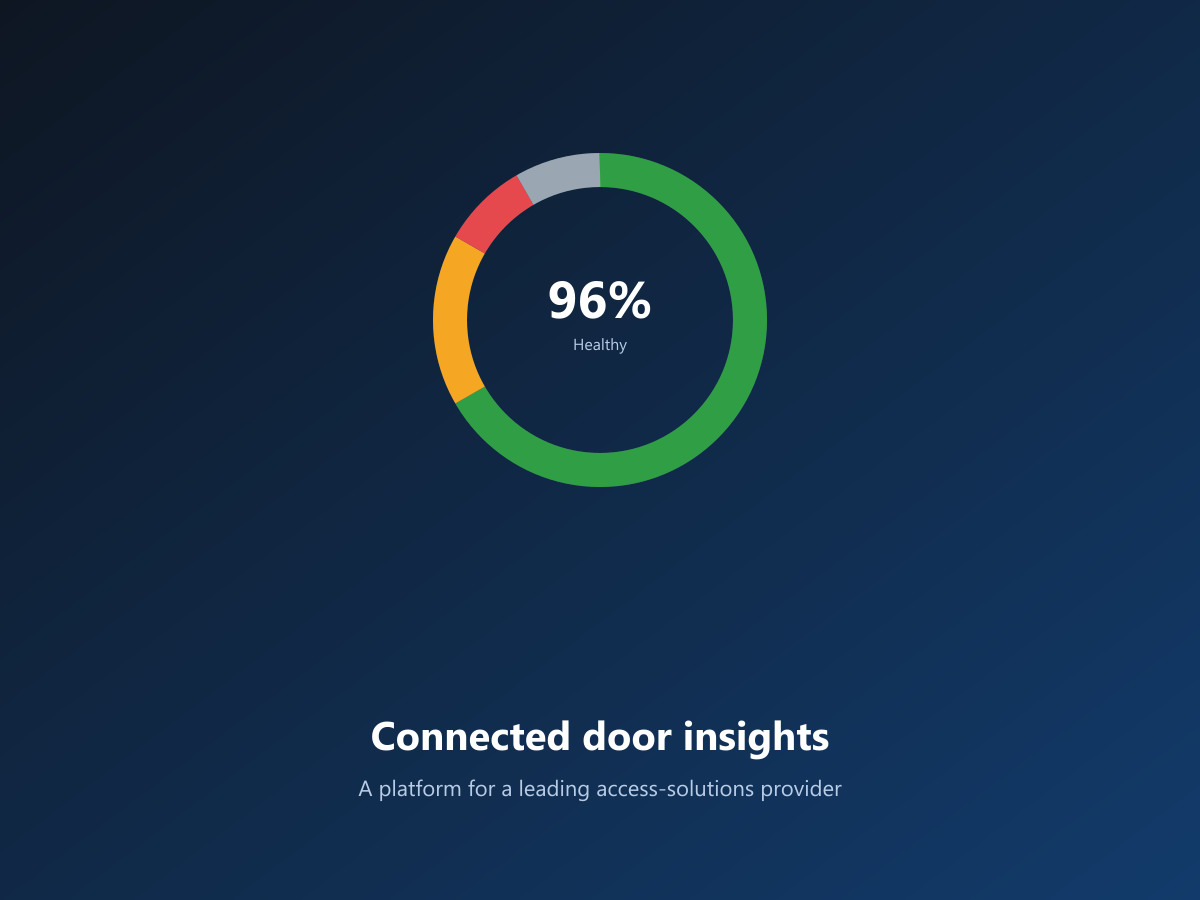
Those services leave the product-specific layer to you. That layer covers the data model for your equipment, the logic that tells a normal reading from an early sign of failure, the escalation rules, the link to your CRM or job system, and the screens your team uses. We build it in the stack that suits your team, such as .NET or Node.js services on Azure, AWS or the cloud you already run. On the connected-door IoT platform we built with our client, that layer picks out anomalies and early signs of failure, triages each fault and escalates it by SMS or email, and shares data both ways with the client’s ERP and CRM systems.
Off-the-shelf IoT solutions suit a fleet that matches their assumptions. When your devices, data or customers fall outside them, a platform composed from cloud services and your own business logic gives you control of the product without building every component from scratch.
Running a device fleet across many sites
With devices on site and the platform in the cloud, the daily job is keeping the fleet current, healthy and reachable. We design for that from the first build.
- ProvisioningEach device gets its identity, certificates and configuration before it reaches site
- Remote managementConfiguration changes, diagnostics and restarts without a site visit
- Monitoring and alertingHeartbeats, health metrics, logs and fault alerts routed to the right person
- Patch managementA record of which signed build each device runs, so operating system and application patches are tracked across the fleet
OTA updates reach every device in the fleet, so we release each one in stages from a single versioned build, with a way back at every step. Edge runtimes such as AWS IoT Greengrass and Azure IoT Edge deploy container releases from a registry, and devices that do not run containers take a signed image through an update agent.
- Build and signEach release is built once from version control by a DevOps release pipeline, signed and stored as an immutable, versioned artefact in a registry such as Azure Container Registry or Amazon ECR
- Bench testThat same build runs on test devices that match the field hardware
- Pilot siteOne site takes the same build first while we watch its health metrics
- CohortsThe rest of the fleet follows in groups, with a pause after each group
- RollbackWe design updates so a device that fails its health checks can return to its last good version
IoT security from the device up
Signed updates are one of several controls built into each device. Connected devices often sit on networks their owners do not fully control, in places people can reach, so security starts on the device itself and carries through to the cloud.
- Secure bootWhere the hardware supports it, devices start only software that carries a trusted signature
- Signed updatesEach OTA package is verified on the device before it installs
- Unique device identityEach device holds its own credentials, with no shared fleet passwords
- CertificatesRotated before they expire, revoked when a device is retired, and checked on site without a call to the cloud
- Least privilegeServices, users and integrations get only the access they need
- Network segmentationDevices sit in their own zone, with only the connections they use
- Audit logsSecurity events recorded on the device and sent on when the cloud is reachable
- Remote accessSessions that are authorised, logged and time-limited
For devices that monitor or control equipment, customers and tenders often name IEC 62443. We design against its component requirements in IEC 62443-4-2 and its system requirements in IEC 62443-3-3, and our guide to IEC 62443 for edge devices shows how the standard fits a connected product. When an existing fleet needs to meet a standard, our secure software development team runs the gap assessment and the remediation, and the fixes reach devices through the same staged rollout.

IoT app development for the people who run the fleet
The third layer is the one people see. Operators and technicians work with the fleet through dashboards and field apps every day, and we design those with the same research and testing we bring to any digital product.
Operations teams get a web app that shows every site on a map, highlights the devices that need attention and lets them act remotely, from changing a setting to restarting a device. Technicians get a native or cross-platform mobile app, built with tools such as Swift, Kotlin or React Native, that guides installation, confirms a device is online and records each site visit. Where customers need access, we build a portal or feed the data into the systems they already use.
We make fault states easy to read, write alerts in plain language, and design field controls to work on a phone with one bar of signal in a plant room.
Bringing an existing device fleet up to date
For a fleet that is already running, our IoT integration services often start by bringing it up to date. The usual triggers are a build team that has moved on to other products, devices on an ageing operating system or spread across different versions, updates done by hand, or a major customer asking for a security review against a named standard.
A fleet refresh typically runs in this order.
- AuditThe devices, software versions, sites and access routes across the fleet, with what we find written up for you
- OwnershipSource code, cloud accounts and credentials moved into your organisation’s name
- Remote managementEach device brought under remote management, with a site visit arranged only where a device cannot be reached remotely
- Release pipelineDevice and platform code put under version control, with a pipeline that builds, signs and stores each release in an artefact registry
- One versionThe fleet moved onto one supported version through staged updates
- Platform planWith the fleet stable, platform fixes and new features planned in priority order
From there, day-to-day support runs under a service level agreement through our software support and maintenance service, which covers the handover, severity levels and monthly reporting.
Planning a connected product, or need support for a fleet already in the field? Talk to the engineers who design, build and support edge and IoT platforms.
Talk to a senior engineerCommon questions about IoT and edge platforms
What are IoT integration services?+−
IoT integration services connect devices in the field to the software that uses their data. That covers the code running on edge devices and gateways, the link to sensors and third-party equipment, the pipeline that moves telemetry to the cloud, the IoT platform that stores and acts on it, and the dashboards and apps people use. We design, build and support each of these layers.
Should we build our own IoT platform or buy one?+−
Usually a mix of both. Managed cloud services such as AWS IoT Core and Azure IoT Hub already handle device connections, identity and messaging, and we use them as building blocks where they fit. What you own is the layer specific to your product, meaning the data model, alert rules, integrations and operator screens. A packaged platform suits a fleet that fits its assumptions. A composed platform suits devices, data or customers that fall outside them.
How do you roll out OTA updates to a device fleet?+−
Each update is built once from version control, signed by the release pipeline and stored as a versioned artefact in a registry. That same build is tested on bench devices and installed at one pilot site, then the rest of the fleet follows in cohorts, with a pause after each while we watch health metrics. Devices verify the signature before installing, and we design updates so a device that fails its health checks can return to its last good version.
What happens to an IoT device when the site loses internet?+−
We design the device to keep running its essential functions on site, with the rules, settings and credentials they need stored locally. Readings and events are held on the device until the cloud confirms them, so none are lost, and settings sync in both directions once the link is back. Operators then see the device catch up on the fleet dashboard, along with how long it was offline.
Which security standard applies to IoT and edge devices?+−
It depends on the product and who buys it. Devices that monitor or control equipment are often specified against IEC 62443, the international series on security for industrial automation and control systems, where part 4-2 covers components and part 3-3 the system. Many consumer-grade connected products sold in Australia fall under the smart device rules made under the Cyber Security Act 2024, which draw on ETSI EN 303 645. We design against the standard your customers and regulators name.
Can you support an IoT fleet another team built?+−
Yes. Fleets often change hands when a product grows or a supplier changes focus. We assess the devices, firmware, cloud accounts and release process, write up what we find, then start support under a service level agreement. Early releases stay small and low risk until we have a baseline for how the fleet behaves in the field.
What if we don’t have the source code for our devices?+−
Start with what your contract says you own. We help you work out what to request, and request access to the cloud accounts and services held in your organisation's name. Where code cannot be recovered, we document how the devices behave and plan replacement software to roll out in stages. For questions about the contract itself, take legal advice.
Who owns the code and IP you write?+−
We set up repositories and cloud accounts in your organisation's name from the start, so the code and accounts stay with you. Ownership of the code we write is set out in your agreement, and we walk you through it before work starts. We work inside those accounts with named access that you control and can remove at any time.
Do you design IoT hardware?+−
We write the software and integrate the hardware, and leave hardware design to specialists. With an existing fleet, we start with the devices already installed and recommend a replacement only where a device cannot be supported. For new products, we work with your engineers or hardware partners to choose off-the-shelf industrial computers, gateways and sensors that suit the site and its security requirements.
How do you integrate industrial IoT devices from different manufacturers?+−
We integrate sensors, controllers and third-party equipment over the interfaces each one provides, from serial links to network protocols and vendor APIs. The edge device translates each one into a common data model before sending it to the cloud, so a mixed fleet from several manufacturers appears on the platform as one set of devices, with the same health checks, alerts and remote actions across the fleet.
IoT and field app case studies


Other technology services All services
- Web & mobile app development
- Systems design & architecture
- Systems integration
- Secure software development
- IoT & edge platforms
- DevOps & hosting
- Customer portal development
- Customer loyalty solutions
- Salesforce app development
- Software Development
- Web application development
- Software & platform support
- Website support & maintenance
Idea, opportunity or problem to solve?
Contact usOffice hours
Monday – Friday8:30am – 5:30pm AEST Closed weekends and
Australian public holidays