What is service design? A practical guide for enterprise teams
Quick answer: Service design is the practice of organising an organisation’s people, processes, technology and touchpoints so a service works for the people who use it and the people who deliver it. Where UX design focuses on a single product or screen, service design takes the wider view across the whole journey a customer has with you over time, including the staff and systems behind each interaction.
Most organisations do not have a product problem. They have a service problem. The website works, the app works, the call centre answers, and yet the experience of dealing with the organisation still feels disjointed: a customer repeats themselves three times across three channels, a frontline worker copies data between two systems that were never meant to talk, a policy written for one purpose quietly breaks the experience somewhere else. Each part functions. The service as a whole does not. Service design is the discipline that works on that gap, the space between the individual touchpoints where most of the friction actually lives.
It is also one of the most misunderstood terms in design, often used interchangeably with UX, CX and design thinking. This guide sets out what service design actually is, how it differs from the disciplines it sits alongside, what an engagement involves, and when it is worth doing.
Service design shapes the whole service, end to end
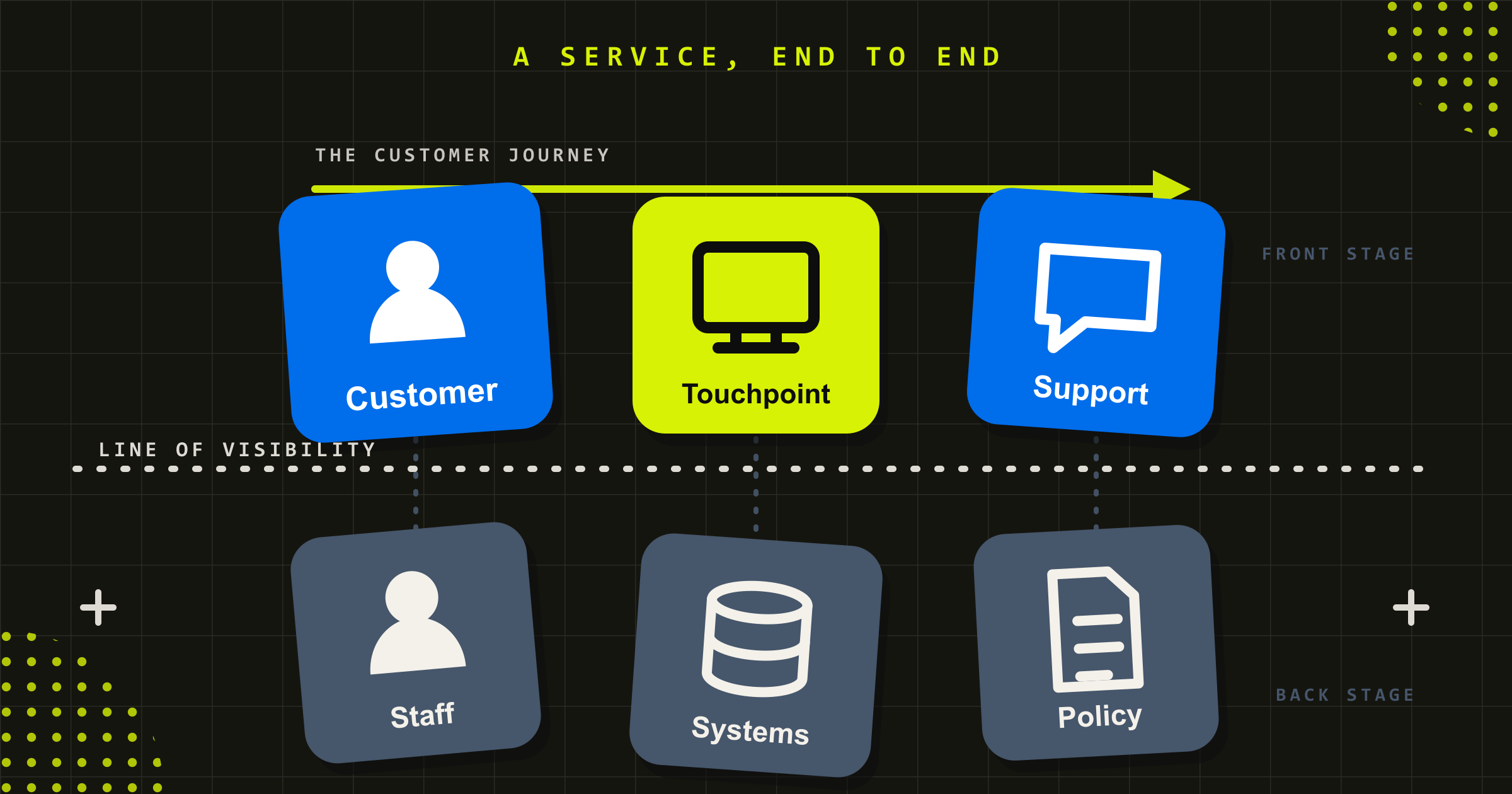
A service is everything that has to happen for a customer to get what they came for. Booking an appointment, renewing a licence, lodging a claim, getting a question answered: each is a service made up of many moments, across many channels, supported by staff, software, policies and physical things. Service design is the practice of shaping all of that as one coherent experience rather than a set of disconnected parts.
The defining move is the shift in scope. A single screen can be well designed and the service can still fail, because the screen is one moment in a much longer chain. Service design widens the frame to the whole chain: what comes before the customer arrives, what happens in the back office while they wait, what the staff member sees on their side of the counter, and what happens after the interaction ends. It treats the front-stage experience and the back-stage operations as one system, because to the customer they are.
Service design, UX, CX and design thinking: where the lines sit
These four terms overlap, which is why they get muddled. The distinctions are worth holding clearly, because they change what you actually commission.
- UX (user experience) design shapes how a person moves through a single product or interface: the structure, the flow, the screens. It is deep and specific. UX and UI design is where a service’s digital touchpoints get built well.
- CX (customer experience) is the customer’s perception of your organisation across every interaction. It is a measure and a strategy: how the relationship is landing, and where to invest to improve it. Customer experience tells you what is working and what is not.
- Service design is the discipline that shapes what produces that experience: the people, processes, systems and touchpoints behind it. CX tells you the service is failing at renewal time; service design rebuilds the renewal service so it stops failing.
- Design thinking is a mindset and a set of methods (empathise, define, ideate, prototype, test) used across all of the above. It is how teams work, not a separate deliverable.
A simple way to hold it: UX designs the screen, CX measures the relationship, service design shapes the whole service that produces both. In practice they are delivered together. At Conduct the same team works across research, service blueprints and interface design, so insight from one informs the others instead of getting lost in handoffs.
What a service design engagement actually involves
Service design is often described in abstract terms, which does it no favours. In practice an engagement is concrete and follows a recognisable arc:
- Discovery and research. Interviews with customers and frontline staff, observation of the service as it runs, and analysis of the data you already hold (support volumes, analytics, complaint themes). The aim is to understand how the service actually works, not how the org chart says it should.
- Mapping the current state. A journey map from the customer’s point of view, and a service blueprint that adds the back-stage layer: the staff actions, systems and policies behind each step. This is where the breakpoints become visible.
- Finding the moments that matter. Not every step is worth fixing. The work is to identify the few points where the experience breaks down or where small changes have outsized effect, and to prioritise them by impact and feasibility.
- Designing the future state. A redesigned service, expressed as a future-state blueprint, with the specific changes to touchpoints, processes, systems or policy needed to get there.
- Outcomes you can act on. You finish with journey maps, service blueprints, research artefacts and a prioritised set of recommendations, sequenced so your team knows what to do first.
The point of the artefacts is not the artefacts. It is the shared understanding they create across teams that usually never sit in the same room: the policy owner, the call-centre lead, the digital team and the customer, all looking at the same picture of the same service.
The service blueprint is the core artefact
If service design has one signature tool, it is the service blueprint. The concept dates to Lynn Shostack’s 1984 Harvard Business Review article, and it has outlasted most design fashions because it does something no other artefact does: it draws the line between what the customer sees and what they do not.
A blueprint lays out the customer’s journey across the top (the front stage), then maps each step down through the layers below it: the staff actions the customer can see, the staff actions they cannot, and the systems and processes that support each one. Drawn this way, a blueprint makes the invisible visible. The reason a customer waits two days for a simple answer is usually not on the screen they are looking at. It is three layers down, in a manual handoff between two systems, and a blueprint is what surfaces it.
When service design pays off, and when it does not
Service design earns its keep when a service is genuinely complex: multiple channels, multiple teams, systems that have grown over time, and an experience that depends on far more than a single product. Government services, health and aged care, utilities and large enterprises are typical, particularly where policy and operations have to move together and where the cost of a poor experience is measured in both satisfaction and operational load.
It is the wrong tool for a simple, single-channel problem. If the issue really is one confusing screen, you need UX design, not a six-week service mapping programme. The skill is matching the method to the actual scope of the problem, and a good practitioner will tell you when the smaller intervention is the right one.
How service design works in government and regulated sectors
Conduct has worked as a service design and research practice since 2008, much of it in government, health and other regulated settings where services are complex by nature and the stakes are high. We have run service design, UX and accessibility work for the NDIS Quality & Safeguards Commission, consulted on UX and accessibility for the Department of Health & Human Services since 2017, and run future-state envisioning with Medibank. Conduct is also on the GovCMS panel.
What these engagements have in common is that the hard part is rarely the interface. It is the alignment: getting policy owners, operational teams, digital teams and the people who actually use the service to agree on what the service should do and how it should run. Service design is the practice that gets them to that agreement, with evidence rather than opinion.
If your organisation is wrestling with a service that has grown complex over time, our service design team can help you map it, find where it breaks, and design the version that works. Fifteen years of practice across government, health and enterprise sits behind that work.
Good products make a single moment work. Service design makes the whole service work, which is usually where the real problem was hiding.
Frequently asked questions
What is service design in simple terms?
Service design is the practice of organising an organisation’s people, processes, technology and touchpoints so a service works for the people who use it and the people who deliver it. It looks at the whole journey a customer has with you over time, including the staff and systems behind each interaction, rather than a single product or screen.
What is the difference between service design and UX design?
UX design shapes how a person moves through a single product or interface. Service design shapes the whole service around them: the staff, processes, policies and systems that produce each interaction. UX is one part of service design. The two are usually delivered together so research and interface design stay connected.
What is a service blueprint?
A service blueprint is the core artefact of service design. It maps the customer’s journey across the top, then the layers beneath each step: the staff actions the customer sees, the actions they do not, and the systems and processes behind them. It makes the invisible back-stage operations visible, which is where most service friction actually lives.
How is service design different from customer experience (CX)?
CX is the customer’s perception of your organisation across every interaction, and the strategy for improving it. Service design is the discipline that shapes what produces that perception: the people, processes and infrastructure behind the experience. CX measures and guides; service design rebuilds the underlying service.
When should an organisation invest in service design?
Service design pays off when a service is genuinely complex: multiple channels, multiple teams, ageing systems, and an experience that depends on more than a single product. Government, health, utilities and large enterprises are typical. For a single confusing screen, UX design is the better-fit, smaller intervention.


Who delivers service design at Conduct?
A senior team of researchers, service designers and UX/UI designers working together, so service blueprints, research and interface design stay connected. Conduct has worked in service design and research since 2008, including for the NDIS Quality & Safeguards Commission, the Department of Health & Human Services and Medibank, and is on the GovCMS panel.
Simon Krambousanos
More from the Journal