Off-the-shelf vs custom software: when a growing organisation should build
Quick Answer: Most organisations should buy off-the-shelf software, not build it. Commercial off-the-shelf (COTS) products are cheaper upfront, faster to deploy and maintained for you. Custom software earns its cost when your workflow is a genuine advantage, your data and integrations are complex, the per-seat licensing of a product would outgrow a one-off build, or no product fits how you work. The answer is usually off-the-shelf, and occasionally, decisively, custom.
You have outgrown something. A spreadsheet that three people now fight over, a starter tool that cannot do the one thing you need, or a product you are paying for and working around in equal measure. The next decision is the one every growing organisation reaches: buy a better product, or build your own?
It is a real fork, and the wrong call is expensive either way. Build when you should have bought, and you have spent six figures recreating something you could have licensed for a monthly fee. Buy when you should have built, and you spend years bending the business to fit software that was never shaped for it. We have spent over 15 years on the build side of that decision, including the Canopy resource management portal for ETS and the Cleanaview customer portal for Cleanaway. The first thing we tell most people is that off-the-shelf is probably the right answer. Here is how to know when it is not.
What commercial off-the-shelf (COTS) software means
Commercial off-the-shelf software, often shortened to COTS, is a finished product you buy or subscribe to and use largely as it comes. Microsoft 365, Xero, Salesforce, Shopify and the thousands of SaaS products behind them are COTS. You are one of many customers, the vendor builds one product for all of you, and you configure it within the limits they allow.
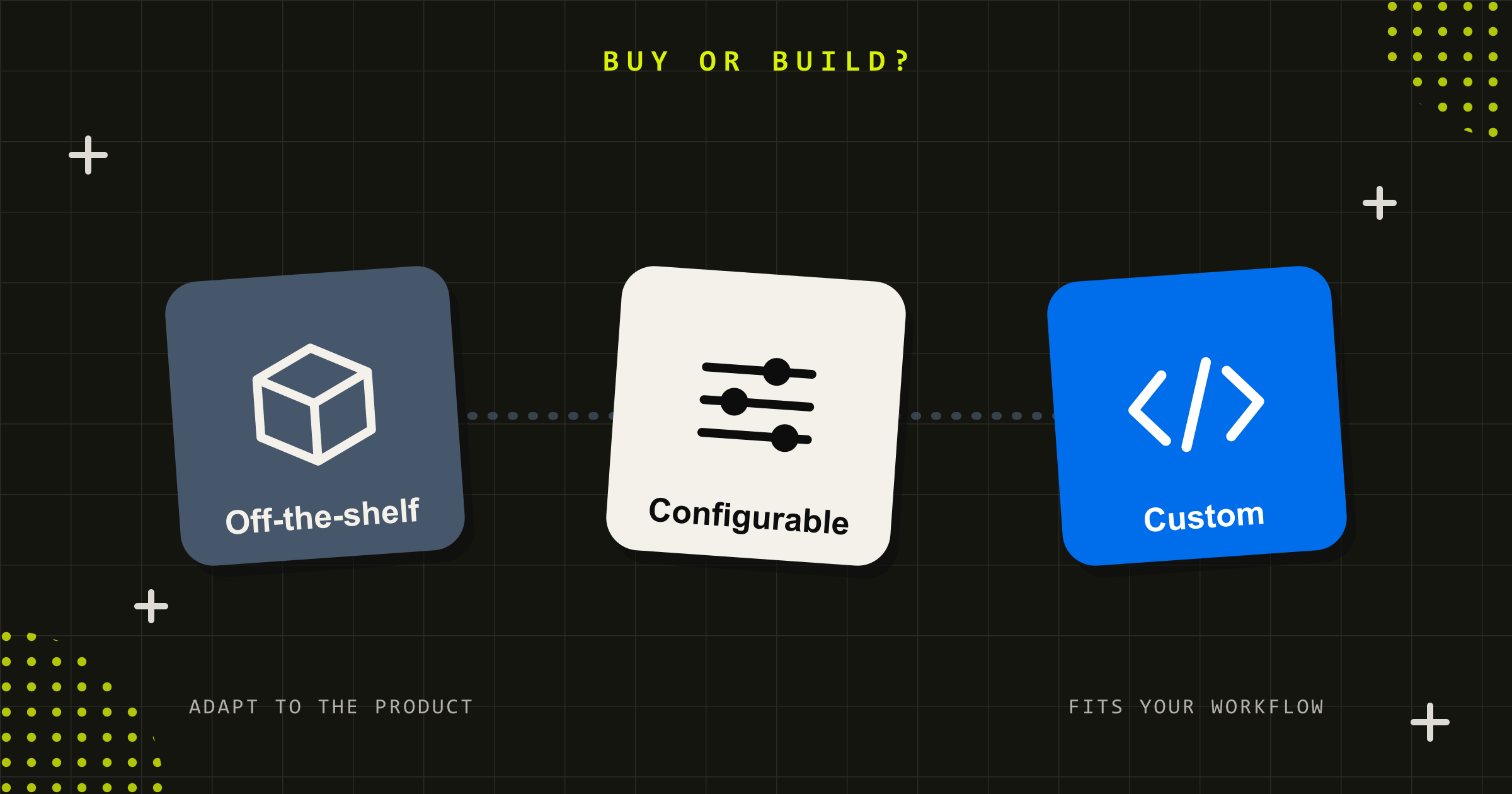
It helps to see software as a spectrum rather than two boxes:
- Off-the-shelf (COTS): you adapt to the product. Fastest and cheapest to start.
- Configurable off-the-shelf: a product with enough settings, fields and rules to bend a fair way toward your process, up to a point.
- Custom (bespoke): software built around your workflow, data and integrations. Slowest and most expensive to start, and the only option that fits exactly.
Most organisations run almost entirely on the left of that spectrum, and should. The build-vs-buy question is really about the small number of systems where the left side stops fitting and the cost of the compromise starts to show.
Off-the-shelf software: where it wins
For the great majority of needs, buying beats building, and it is not close.
- Cost and speed. Someone else has already absorbed the build cost across thousands of customers. You are live in days or weeks, for a subscription, not a project budget.
- Maintenance is the vendor’s problem. Security patches, updates, uptime, backups and compliance certifications are theirs to fund and run, not yours.
- It is proven. A mature product has been tested by every customer before you. The bugs you would have discovered the hard way are mostly already found and fixed.
- It keeps improving. A good vendor ships new features you did not pay to build.
If your need is common, accounting, email, payroll, CRM, a basic online store, there is almost always a product that does it well. Building your own version of a solved problem is the most reliable way to waste money in technology. When we are asked to build something a product already does, we say so.
Custom software: where it wins
Custom earns its place when the thing you need is specific to you, or strategic to you, or both.
- Exact fit. The software follows your workflow instead of forcing your team into someone else’s. For a process that is core to how you operate, that fit is the whole point.
- Integration. It connects to the other systems you run, with the data flowing the way your business works, rather than the handful of integrations a vendor chose to support.
- Scale and performance. It is designed for your data volumes and your load, with no per-record ceiling or feature wall to hit later.
- Ownership and economics. You own the system. There is no per-seat licence climbing with every hire, and no vendor deciding to deprecate the feature you depend on or triple the price at renewal.
The Cleanaview portal for Cleanaway and the Zero Net Carbon modelling tool for Sustainability Victoria are the kind of systems organisations commission when no product fits the workflow or the data. That is the test: not whether custom would be nicer, but whether the off-the-shelf compromise is one you can live with for years.
Off-the-shelf vs custom software: a side-by-side
When we weigh off-the-shelf against custom with a client, these are the dimensions that decide it.
| Dimension | Off-the-shelf (COTS) | Custom software |
|---|---|---|
| Upfront cost | Low (subscription) | High (a build project) |
| Time to live | Days to weeks | Months |
| Fit to your workflow | You adapt to the product | The software fits your process |
| Ongoing cost | Per-seat, recurring, climbs with headcount | Hosting and maintenance, not per-seat |
| Integration | Limited to what the vendor supports | Whatever your systems require |
| Scalability | The vendor’s roadmap and limits | Designed around your needs |
| Maintenance and security | The vendor’s responsibility | Yours, or your build partner’s |
| Ownership and control | You rent access | You own the system |
| Best when | Your need is common | Your need is specific or strategic |
No row in that table is a verdict on its own. A high upfront cost is fine if the workflow is your competitive edge; a low subscription is poor value if your team spends every day working around the product. The decision is about which trade-offs you can carry, which is why it comes down to a handful of questions rather than a feature count.
The build-vs-buy questions we ask on every project
This is the working list we take into a build-vs-buy conversation. Work through these and the decision usually makes itself.
- Is this process a commodity or an advantage? Payroll and email are commodities, so buy them. The process you do better than your competitors may be worth building around.
- Does a product genuinely fit, or would you configure and work around it heavily? Heavy workarounds are the hidden cost of “just buying it”, paid every day in lost time.
- How unusual are your data model and the systems you need to connect to? The more they differ from what a standard product assumes, the sooner you run into limits it can’t work around.
- What does the off-the-shelf option cost over five years at your user count? A per-seat subscription that scales with headcount can quietly overtake a one-off build. Compare the five-year figure, not the first invoice.
- What are your compliance, security, accessibility and data-residency obligations? Sometimes these narrow the field to custom, or to a managed platform like GovCMS for government, where the heavy lifting is handled but the build is still yours. Our government work lives in that space.
- How much control do you need over the roadmap? If you cannot afford to wait on a vendor’s priorities or absorb a feature being removed, ownership matters.
- Can you specify, commission and maintain a custom build? If you do not have the capability or a partner who does, a well-chosen product is the safer call.
Why the answer is often both
The build-vs-buy framing suggests a single choice, but the strongest setups are usually a mix. You buy the commodities and build only the part that is genuinely yours.
In practice that often means off-the-shelf products for accounting, email, payroll and the rest, with a custom application for the workflow that defines the business, and an integration layer connecting them so data moves cleanly between the two. You get the economy of products where the need is common and the fit of custom where it counts. The skill is drawing that line in the right place, and it is most of what a good build partner does before any code is written.
When the thing you have outgrown is a spreadsheet or a starter tool
For a lot of organisations the build-vs-buy question arrives the same way: a spreadsheet, a Microsoft Access database, or a low-code app that started as a clever shortcut and quietly became business-critical. It is multi-user now, it holds data you cannot afford to lose, and it is showing its limits.
The decision is the same one this guide describes. Sometimes the answer is a fit-for-purpose off-the-shelf product you should have moved to earlier. Sometimes the workflow is specific enough that the spreadsheet was a homemade version of software that needs to be properly built. If you are weighing that move, we have written separately about when a Power Apps build stops scaling and converting a Microsoft Access database into a web application, which walk through the rebuild in detail.
Making the call
Conduct has spent over 15 years, since 2008, helping organisations decide what to build and what to buy, and then building the part worth building. We are an in-house Australian team of senior engineers and designers, a 7-time Good Design Award winner, and we work across government, health, enterprise and not-for-profit organisations where the stakes are real. Because we only build custom when it is the right answer, we will tell you if buying is the better call. If you are facing a build-vs-buy decision, talk to us about custom software development, and our software development cost guide sets out what a custom build costs in Australia if that is the way you land.
The best software decision is not the one that builds the most, or the one that spends the least. It is the one that matches the tool to the stakes.
Frequently asked questions
What is commercial off-the-shelf (COTS) software?
Commercial off-the-shelf (COTS) software is a finished product you buy or subscribe to and use largely as it comes, rather than have built for you. Microsoft 365, Xero, Salesforce and Shopify are examples. The vendor builds one product for many customers, handles maintenance and security, and lets you configure it within set limits. It is cheaper and faster than custom software, at the cost of an exact fit.
Is custom software better than off-the-shelf?
Not usually. For common needs like accounting, email or CRM, off-the-shelf is cheaper, faster and lower-risk, and it is the right call for most systems in most organisations. Custom software is better only when your workflow is specific or strategic, your data and integrations are complex, or a product cannot fit how you work. “Better” depends entirely on how unusual your need is.
When should you build custom software instead of buying?
Build when the process is a competitive advantage rather than a commodity, when no product fits without heavy workarounds, when your data and integrations are complex, when per-seat licensing at your scale would overtake a one-off build, or when compliance and control requirements demand it. If several of those are true, custom usually pays for itself. If only one is, it is often too early.
Is custom software more expensive than off-the-shelf?
Upfront, almost always. A subscription product is live in weeks for a monthly fee, while a custom build is a project measured in months. Over five years the gap narrows and can reverse: per-seat licensing climbs with every hire, while a custom system runs on hosting and maintenance you control. Compare the five-year total, not the first invoice.
What are the disadvantages of off-the-shelf software?
You adapt to the product rather than the other way around, so a process that does not match the vendor’s assumptions means daily workarounds. Integrations are limited to what the vendor supports, per-seat costs grow with headcount, and you depend on the vendor’s roadmap, pricing and decisions, including the risk of a feature being removed or a product being discontinued.
Can you combine off-the-shelf and custom software?
Yes, and it is often the strongest approach. Most organisations buy off-the-shelf products for commodity needs (accounting, email, payroll) and build custom only for the workflow that defines the business, with an integration layer connecting them. This gives you the economy of products where the need is common and the fit of custom where it matters, rather than forcing one approach across everything.


Should a small business build custom software?
Usually not. A smaller organisation is better served putting its budget into well-chosen off-the-shelf products and configuring them well. Custom software makes sense once a specific process is central enough that the off-the-shelf compromise is genuinely costing you, in time, in lost opportunity, or in a workflow that no product supports. That threshold is about the stakes of the process, not the size of the company.
Charlie Pohl
More from the Journal