The complete guide to customer journey mapping
Quick answer: Customer journey mapping is the practice of visualising every step a person takes to reach a goal with your organisation, from the first trigger to well after the sale, alongside what they are doing, thinking and feeling at each step. Done well, it turns scattered assumptions about the customer into one shared picture a team can act on. Done as a poster nobody reads, it changes nothing.
Most organisations already believe they understand their customers. Then they map the actual journey, and the room goes quiet.
The quiet comes from seeing, often for the first time, how far the real experience sits from the tidy version in everyone’s head. The steps nobody owns. The point where three departments each assume another is handling it. The moment a customer gives up and calls the contact centre, which the website was supposed to prevent. A customer journey map makes that visible, and visibility is what forces a decision. This guide covers what a journey map actually is, what goes into one, and a repeatable way to build one that survives contact with a real organisation.
What customer journey mapping actually is, and what it isn’t
The Nielsen Norman Group describes a customer journey map as a visualisation of the process a person goes through to accomplish a goal. That definition is deliberately plain, and it matters, because the term gets stretched to cover things it shouldn’t.
A customer journey map is not a sales funnel. A funnel is what your organisation wants to happen. A journey map is what the customer actually experiences, which usually includes the parts your funnel pretends don’t exist: the confusion, the abandoned form, the second and third visit before anyone converts.
It is also not a service blueprint, though the two are close cousins (more on that below). And it is not a one-off workshop artefact. The map is the output; the value is in the shared understanding it builds and the decisions it changes. A beautiful map that lands in a drawer has cost you money, not saved it.
At its core, a good map holds a mirror up to the organisation. That is uncomfortable, and it is the point.
Why customer journey mapping matters for established organisations
The larger the organisation, the more the customer experience fragments across teams, systems and channels, and the harder it becomes for any one person to see the whole thing. Marketing owns acquisition. Sales owns conversion. A product team owns the app. Operations owns fulfilment. The customer, meanwhile, experiences one continuous journey and does not care where your internal boundaries sit.
That fragmentation is where the cost hides. A handoff that drops. A message that contradicts the one sent a step earlier. A moment of genuine frustration that no single team is measured on, because it happens in the gap between them. Journey mapping is one of the few tools that reassembles the whole picture and makes those gaps a shared problem rather than an orphaned one.
For enterprise and government teams especially, the map also does something political in the best sense: it gives people from different divisions a single, neutral artefact to argue over. The debate stops being “my team versus yours” and becomes “here is where the customer is being let down, what do we do about it.” We have watched that shift turn a stalled project into a funded one in a single afternoon.
The anatomy of a customer journey map
Maps vary in style, but the useful ones share a common spine. When we build one, these are the layers we work through:
- Stages. The high-level phases of the journey, in the customer’s terms, not yours. For a service that might be: become aware, evaluate, commit, get set up, use, get help, renew or leave.
- Actions. What the person actually does at each stage. The specific steps, clicks, calls and waits.
- Thoughts and questions. What is going through their mind. “Is this the right option for me?” “Why is it asking for this again?”
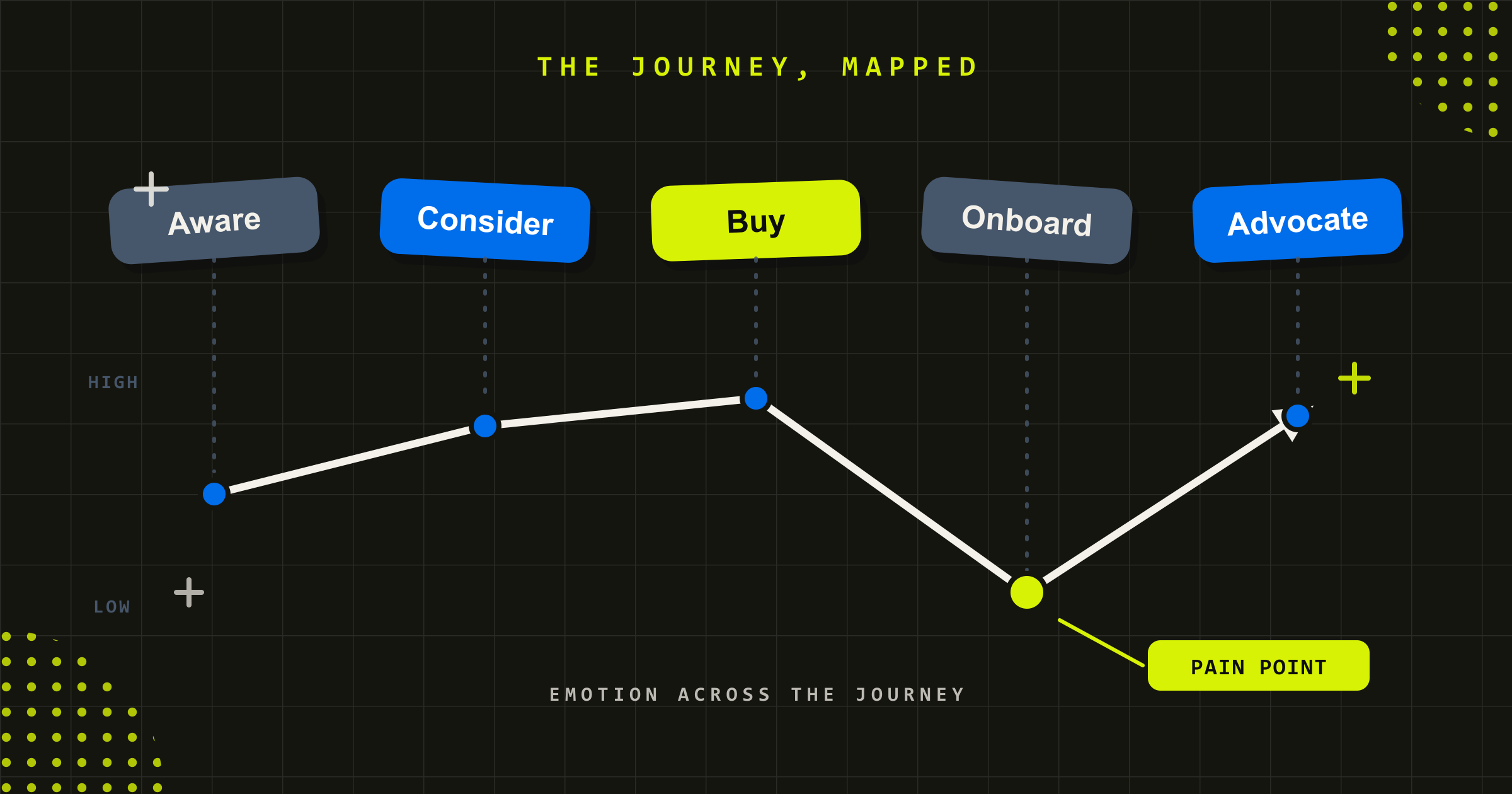
- Emotions. The emotional high and low points across the journey, usually drawn as a line. This is where a map earns its keep, because the troughs are where you are losing people.
- Touchpoints and channels. Where each step happens: website, app, email, contact centre, physical location, a letter in the post.
- Pain points. The friction, dead ends and moments of doubt, marked clearly.
- Opportunities. For each pain point, the thing you could do about it. A map without this column is a diagnosis with no treatment.
The emotion line is the part executives remember. A single downward spike at “waiting to hear back after I applied” says more, and moves more budget, than a page of survey averages.
How to build a customer journey map: a seven-step framework
A journey map is only as good as the evidence under it. The failure mode we see most often is a team mapping their assumptions in a meeting room and calling it research. Here is the sequence we use to avoid that.
- Define the scope and the persona. One journey, one type of person, one goal. “Every customer” is not a scope. “A first-time NDIS participant setting up their supports” is.
- Ground it in real research. Interviews, session recordings, support-ticket analysis, analytics. The map is a synthesis of evidence, not opinion. This is the step organisations skip and the reason most maps are fiction.
- Map the current state first. Chart the journey as it actually is today, warts and all, before anyone is allowed to design the ideal. You cannot fix what you refuse to look at.
- Plot the emotional line. Mark the highs and, more importantly, the lows. The lows are your backlog.
- Mark pain points and their root cause. Not just “the form is long” but why: a system limitation, a policy, a handoff, a piece of missing information.
- Identify opportunities and prioritise them. For each low point, what could change, and what is the effort-to-impact trade-off. This turns the map into a roadmap.
- Socialise it and keep it alive. Put it where the teams who own the touchpoints will see it, and revisit it as things change. A map is a living reference, not a deliverable you sign off and forget.
If you only take one of these, take the second. A map built on real evidence changes decisions. A map built on assumptions just makes the assumptions look official.
Customer journey mapping vs service blueprinting
These two get used interchangeably, and they shouldn’t. A customer journey map looks outward, at what the customer experiences. A service blueprint looks inward, at what your organisation has to do, front-stage and back-stage, to deliver that experience: the staff, systems, policies and processes behind each touchpoint.
The simplest way to hold them together: the journey map tells you where the experience is failing; the blueprint tells you why, in operational terms, and what you would have to change to fix it. You often need both, and they are core tools of the same discipline. If you want the wider picture, our guide to what service design is covers how the two fit together.
Where customer journey maps go wrong
The tool is sound; the execution is where value leaks. The recurring mistakes:
- Mapping the ideal instead of the real. Skipping straight to the aspirational journey because the current state is embarrassing. The embarrassment is the finding.
- No evidence underneath. A workshop of internal assumptions dressed up as insight.
- Too broad. One map trying to cover every customer and every scenario, so it describes no one.
- No owner for the opportunities. A wall of pain points and no one accountable for acting on them.
- Built once, never revisited. The organisation changes; the map doesn’t; it quietly becomes wrong.
We have seen this pattern across sectors. When we worked with the Royal Children’s Hospital on the experience of children facing daunting medical imaging, the value was not a diagram. It was understanding the emotional low points in a child’s journey precisely enough to design something that met them there. When we rebuilt Cleanaway’s self-service portal, mapping the real customer journey is what surfaced where the old experience forced people to pick up the phone. The map is a means. The changed decision is the end.
Where Conduct fits
We have spent since 2008 helping established organisations across government, health, energy and enterprise understand their customers before they build for them. Journey mapping sits inside our customer experience and UX and UI design work, always grounded in real user research rather than a room full of assumptions. We have done this for the DHHS, for national brands and for public-sector services used by millions of Australians. The maps are never the point. The better decisions they force are.
A customer journey map is worth exactly as much as the decisions it changes. Build it on evidence, point it at the emotional lows, and give someone the job of acting on what it shows.
Frequently asked questions
What is customer journey mapping?
Customer journey mapping is the practice of visualising every step a person takes to reach a goal with your organisation, from first awareness through to use and renewal, alongside what they do, think and feel at each step. It reassembles a fragmented experience into one shared picture, so a team can see where customers are being let down and decide what to fix.
What are the stages of a customer journey?
Stages vary by organisation, but a common structure runs: awareness, evaluation, commitment or purchase, onboarding or setup, ongoing use, support, and renewal or exit. The key is to define stages in the customer’s terms, not your internal process. One journey and one type of customer per map keeps it useful rather than generic.
What is the difference between a customer journey map and a service blueprint?
A customer journey map looks outward at what the customer experiences. A service blueprint looks inward at what your organisation does, front-stage and back-stage, to deliver that experience. The journey map shows where the experience fails; the blueprint shows why, operationally, and what you would change. Complex problems usually need both.
What research do you need before mapping a journey?
A credible map is built on evidence, not a meeting-room guess. That means customer interviews, session recordings, support-ticket and complaint analysis, and analytics on where people drop off. Skipping this step is the single most common reason journey maps fail: they end up documenting internal assumptions rather than real behaviour.
Who should be involved in customer journey mapping?
The people who own the touchpoints along the journey: marketing, sales, product, operations, support, and often frontline staff who see the reality daily. A journey map’s quiet power is giving different divisions one neutral artefact to work from, so the conversation shifts from “my team versus yours” to “here is where the customer is struggling.”


How often should a customer journey map be updated?
Treat it as a living reference, not a one-off deliverable. Revisit it whenever the underlying service, systems or customer behaviour changes materially, and at least annually. A map that is signed off and filed away slowly drifts out of step with reality until it is quietly wrong, which is worse than having no map at all.
Simon Krambousanos
More from the Journal